
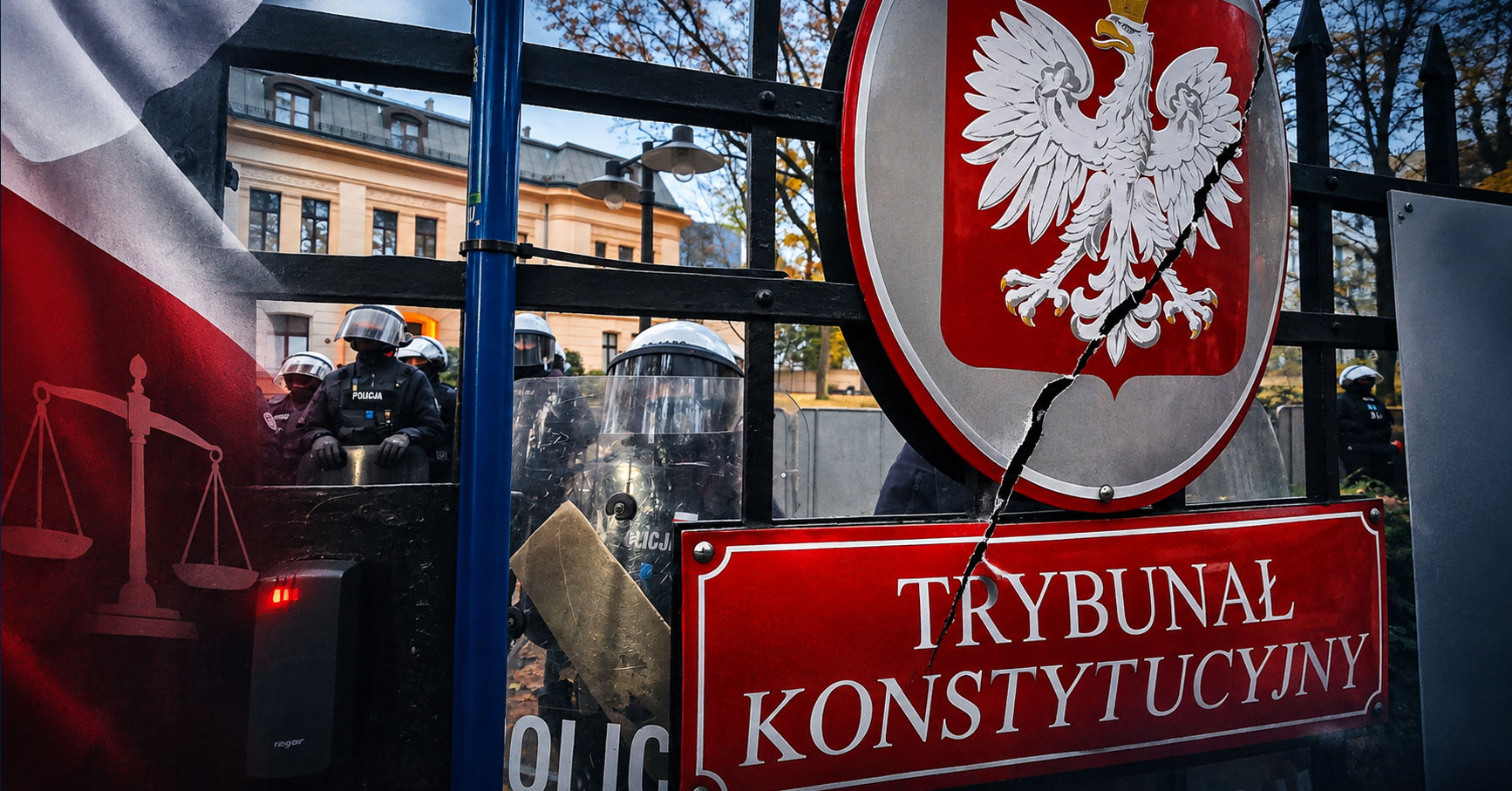
Analysis of the 2026 Constitutional Crisis in Poland: Specific Legal Issues
Relevance of the research. Democracy must not only guarantee rights and freedoms, but also be able to protect itself from those who attempt to limit or even destroy it. It must have legal mechanisms to counter encroachments against itself, while maintaining a balance — the protection of democracy should not become a justification for unlimited power and violations of human rights.
On October 30, 2026, in Poland, one of the judges of the Constitutional Tribunal (hereinafter referred to as CT) elected by the Polish Sejm, who was not allowed to work by the Tribunal’s leadership, ordered an immediate suspension of the CT Chairman’s official actions, citing “stan wyższej konieczności konstytucyjnej” [1]. Reacting promptly to this decision, the President of Poland arrived at the CT building at night along with the First President of the Supreme Court, attempting to enter. The situation escalated to skirmishes between the highest officials of the Republic of Poland and fights among the judges [2].
When a dispute over the right (to start the work of a newly elected CT judge) turns into a dispute over who controls the court building, we should return to the root cause: which norm should be applied, who is authorized to interpret it, and whether there is a resolution to the legal problem. For Ukraine, which has its own experience of conflicts surrounding the body of constitutional control, the Polish experience demonstrates the possible consequences of avoiding these problems.
State of the research. The concept of ‘militant democracy’ was formulated by Karl Lowenstein as a response to the use of democratic freedoms by anti-democratic movements to seize power. [3, p. 417–432]; in Poland it was long reduced to the theory of party prohibition. A notable step was A. Bień-Kacala’s typology, which alongside militant and neo-militant democracy highlighted quasi-militant democracy – the use of protective instruments by the current authorities under the banner of defending democracy [4, s. 378]. After 2023, the scientific community in Poland shifted the discussion to the realm of ‘restoring the rule of law’. For instance, M. Safjan advocates restoration through the direct application of the Constitution of the Republic of Poland, EU law, and the practices of European courts, while acknowledging the risks involved [5]. Hungarian scholar András Sajó suggests ‘militant rule of law’ – the application of exceptions already recognized by rule of law standards [6], and Z. Kmiecik considers Loewenstein’s methods necessary for the restoration of order [7]. According to J. Stelina, only a broad consensus, i.e., a change in the Constitution of the Republic of Poland, will end the conflict around the Constitutional Tribunal [8, s. 114]; authors of the monograph edited by M. Muszyński even write about ‘inverted rule of law’ [9]. However, the recent events of 2026 have not yet received comprehensive understanding. The purpose of this article is to identify the key legal problems of the constitutional crisis and outline legitimate ways to overcome it.
Main content. The first and essentially central problem is the legal nature of the oath of a Constitutional Tribunal judge. The Constitution of the Republic of Poland grants exclusively the Sejm the right to elect Constitutional Tribunal judges, with ‘indywidualnie’ [10, ч. 1 ст. 194]; the Basic Law of Poland is silent about the President’s participation. The mention of the oath appears only at the legislative level: the elected person ‘takes the oath before the President’ [11, ч. 1 ст. 4], and the refusal to take it ‘is equivalent to renouncing the position’ [11, ч. 2 ст. 4]. Let us draw attention to the construction of the norm: it describes the action of the chosen person, not the President; the legislator foresees the consequence of refusing to take the oath, but does not foresee the consequence of inaction by the person before whom it is taken. This asymmetry became the legal core of the crisis; its interpretation even affects the composition of the General Assembly of the Constitutional Tribunal. [12, ч. 1 ст. 6]. It is difficult to find an explanation for why such a legal gap has arisen.
Looking retrospectively, the position of the Constitutional Tribunal changed to the opposite. In 2015, the Tribunal recognized that the corresponding norm, if understood differently than as one that imposes the duty on the President of ‘immediate administering of the oath’, contradicts Part 1 of Article 194 of the Constitution of the Republic of Poland. [13, п. 5 резолютивної частини]. However, on May 12, 2026, the Constitutional Tribunal, consisting of five judges, concluded by a vote of three to two that Part 1 of Article 4 of the law, if understood as imposing the duty on the President to accept the oath, does not comply with Article 126 in connection with Article 2 of the Constitution of the Republic of Poland. [14].
The Venice Commission, on the contrary, views the administering of the oath as a ceremonial act: the President must administer it without delay and is not entitled to check the election procedure, and if he refuses, the oath in an appropriate form without his physical presence is permissible. [15]. We are faced not with shades of interpretation, but a direct conflict, which cannot be resolved through interpretation.
Another issue is the competition between two different interpretations of legal norms. The Court of Justice of the EU stated that the Constitutional Tribunal does not meet the requirements of an independent and impartial court, as previously established by law. [16]. Meanwhile, the Constitution of the Republic of Poland declares the decisions of the Constitutional Tribunal as ‘generally binding and final’ and requires their immediate publication [10, ч. 1, 2 ст. 190], while the government recognized the publication of Constitutional Tribunal acts in the current composition as inadmissible [17]. Each side accuses the other of violating the principle of legal certainty [10, ст. 7]. Paradoxically, there are now such diverse interpretations of two norms of the Constitution of the Republic of Poland, which provide mutually exclusive answers to one question, and the arbiter (Constitutional Tribunal) provided for by the Constitution is itself the subject of dispute.
The third problem is the applied ‘state of higher constitutional necessity’. Written constitutional law of Poland does not know such a concept; the closest equivalent is criminal law: no crime is committed by one who eliminates a direct danger, ‘if the danger cannot be otherwise avoided’, and the sacrificed good is less valuable than the saved one [18, § 1 ст. 26] (extreme necessity). However, the circumstance that excludes the criminality of the act answers the question of whether a physical person is liable, not whether a state body had the authority to act or omit to act; transferring it to public law is a methodological error and an expansive interpretation. The Constitution of the Republic of Poland contains a closed list of states of emergency, which are introduced only when ‘ordinary constitutional measures are insufficient’ [10, ч. 1 ст. 228], and a state of emergency due to a threat to constitutional order is introduced by the President only on the proposal of the Council of Ministers [10, ч. 1 ст. 230]. This boundary is symmetrical: the function of the President to ensure adherence to the Constitution of the Republic of Poland [10, ч. 2 ст. 126] is realized ‘within the scope and on the principles defined in the Constitution and laws’ [10, ч. 3 ст. 126]. They do not change the picture, but rather complicate it, and mutual accusations of “coup” between parties: this crime requires the aim of a violent change of order. [18, § 1 ст. 127].
The fourth problem is whether the doctrine of ‘militant democracy’ is suitable for the current constitutional crisis in Poland. The Constitution of the Republic of Poland contains its classic element: the prohibition of parties and organizations whose programs or activities involve or allow methods and practices of totalitarian regimes, racial and national hatred, violence to seize power or influence state policy, as well as secret structures. [10, ч. 1 ст. 13]. However, it is a tool for protecting political pluralism from anti-democratic associations, not a means to resolve conflicts between constitutional bodies. Accordingly, applying this doctrine to the current crisis would go beyond its intended purpose.
In contemporary Polish discourse, the concept of ‘militant democracy’ is sometimes used much more broadly – as a justification for extraordinary state actions to restore the rule of law. But such an approach creates the danger of turning democracy’s protective mechanisms into a tool for political struggle. As A. Bień-Kacała rightly points out, democratic institutions can be used by the current government to limit political competition if the authority itself determines what constitutes a threat to democracy. [4]. In this sense, the current crisis demonstrates the risk of quasi-militant democracy, where the protection of law and order becomes an argument for retreating from its procedural guarantees.
The fifth problem is the lack of an effective mechanism for resolving disputes between constitutional bodies. The Constitution of the Republic of Poland does not provide a specific procedure for resolving conflicts between the President, the Sejm, the government, and the Constitutional Tribunal on the status of judges. The CT has the authority to resolve disputes over powers between the central constitutional bodies of the state [10, ч. 1 ст. 189], however, in a situation where the Tribunal itself is a party to the conflict, this mechanism loses practical effectiveness.
Resolving the crisis. In our opinion, the solution to the problem should occur exclusively within the legal framework and involve several sequential steps. First of all, it is necessary to legislatively clarify the procedure for the oath-taking by CT judges: to establish a clear deadline for its acceptance by the President, as well as to provide legal consequences for his inaction. At the same time, the legislator must take into account the constitutional role of the Sejm as the body that selects the Tribunal’s judges and must not create additional powers for the President not provided for by the Constitution.
Secondly, decisions of international judicial institutions, especially the Court of Justice of the EU (in the case ‘European Commission v. Republic of Poland’ dated December 18, 2025), should be enforced by law, not by resolutions of the Sejm or government; interim measures must be time-bound and controlled by the court. Thirdly, the final status of the CT can only be regulated by amending the Constitution (2/3 majority in the Sejm and an absolute majority in the Senate. [10, ч. 4 ст. 235]), which individualizes the settlement of the status of persons elected with violations, and will not affect the immutability of legitimately elected judges [22]. Appropriate and constitutional enshrinement of the Tribunal’s resilience guarantees is advisable – modeled after the amendments to Articles 93–94 of the Basic Law of Germany in 2024. [20]. However, without the consensus of the main political forces, which A. Glischinska-Grabias emphasizes [23, s. 27], none of these steps will be implemented.
Conclusion. The core of the crisis is the conflict of interpretations of Part 1, Article 194 of the Constitution of the Republic of Poland and Part 1, Article 4 of the Law on the Status of CT Judges, caused by a gap concerning the inaction of the oath recipient. Decisions of supranational courts and the norm of the mandatory nature of the CT’s decisions have created a state of competing legalities without a recognized arbiter.
The ‘state of higher constitutional necessity’ cannot be a source of authority for any body. The Constitution of the Republic of Poland contains only separate provisions of the ‘militant democracy’ model aimed against anti-system associations, thus this doctrine cannot be the basis for the actions of state bodies in an inter-institutional conflict. In our opinion, the lawful exit from the current crisis is the legislative regulation of the oath, the implementation of international decisions through amendments to the law, and a consensual change to the Constitution of the Republic of Poland with guarantees of the immutability of judges.
List of used sources
- Co się dzieje w Trybunale Konstytucyjnym? Wyjaśniamy. Rzeczpospolita. 2026. URL: https://www.rp.pl/polityka/art45424911-co-sie-dzieje-w-trybunale-konstytucyjnym-wyjasniamy (accessed: 02.11.2026). ↩
- Prezydent przed Trybunałem Konstytucyjnym. Towarzyszy mu I prezes Sądu Najwyższego. Polsat News. 31.10.2026. URL: https://www.polsatnews.pl/wiadomosc/2026-10-31/prezydent-przed-trybunalem-konstytucyjnym-towarzyszy-mu-i-prezes-sadu-najwyzszego/ (accessed: 02.11.2026). ↩
- Loewenstein K. Militant Democracy and Fundamental Rights, I. The American Political Science Review. 1937. Vol. 31, No. 3. P. 417–432. ↩
- Bień-Kacała A. Can democracy still defend itself in Poland? Państwo i Prawo. 2022. No. 10. P. 374–391. ↩ ↩
- Safjan M. We Are Not Helpless: How Poland can restore the Rule of Law by referring to its constitutional foundations. Verfassungsblog. 06.12.2023. DOI: 10.59704/360b3642fd7715d0. ↩
- Sajó A. Militant Rule of Law. Verfassungsblog. 20.12.2023. DOI: 10.59704/309ff22756f26063. ↩
- Kmieciak Z. Regression or Temporary Crisis of the Rule of Law? State and Law. 2024. No 10. P. 5 and onwards. ↩
- Stelina J. On Persons “Not Authorized to Adjudicate” as Referred to in the 2024 Acts Concerning the Constitutional Tribunal. European Review of Law and International Relations. 2025. No 1(73). P. 114–124. DOI: 10.52097/eppism.9661. ↩
- Reversed Rule of Law in the Creation, Interpretation and Application of Law in Poland: Methods and Consequences / ed. M. Muszyński. Miskolc–Budapest: Central European Professors’ Network, 2026. DOI: 10.54237/profnet.2026.mmrrlcialp. ↩
- Constitution of the Republic of Poland of April 2, 1997. Journal of Laws 1997. No 78. Item 483. ↩ ↩ ↩ ↩ ↩ ↩ ↩ ↩ ↩ ↩
- Act of November 30, 2016 on the Status of Judges of the Constitutional Tribunal. Journal of Laws 2018. Item 1422 (as amended). ↩ ↩
- Act of November 30, 2016 on the Organization and Procedure of the Constitutional Tribunal. Journal of Laws 2019. Item 2393 (as amended). ↩
- Judgment of the Constitutional Tribunal of December 3, 2015, case ref. K 34/15. Journal of Laws 2015. Item 2129. ↩
- Judgment of the Constitutional Tribunal of May 12, 2026, case ref. K 3/26 [according to Prawo.pl]. URL: https://www.prawo.pl/prawnicy-sady/obowiazek-przyjecia-slubowania-przez-sedziow-tk-wyrok-trybunalu-konstytucyjnego,1544501.html (accessed: 02.11.2026). ↩
- Venice Commission. Poland – Opinion on the powers of the President in the context of the oath-taking of the judges of the Constitutional Tribunal and of other judicial appointments: CDL-AD(2026)031. 9–10.10.2026. ↩ ↩
- Judgment of the Court of Justice of the European Union of December 18, 2025, C-448/23, Commission v. Poland. Press Release No 157/25. ↩
- Resolution No 162 of the Council of Ministers of December 18, 2024 on counteracting the negative effects of the constitutional crisis in the judiciary. Official Gazette 2024. Item 1068. ↩
- Act of June 6, 1997 – Penal Code. Journal of Laws 2025. Item 383 (as amended). ↩ ↩
- Judgment of the Constitutional Tribunal of December 3, 2025, case ref. Pp 1/20. ↩
- Basic Law for the Federal Republic of Germany of May 23, 1949 (last amended: Federal Law Gazette 2024 I No 439). ↩ ↩
- Müller J.-W. Militant Democracy and Constitutional Identity. Comparative Constitutional Theory / ed. by G. Jacobsohn, M. Schor. Cheltenham: Edward Elgar, 2018. P. 415–435. ↩
- Venice Commission. Poland – Opinion on the draft constitutional amendments concerning the Constitutional Tribunal and two draft laws on the Constitutional Tribunal: CDL-AD(2024)035. 6–7.12.2024. ↩
- Gliszczyńska-Grabias A. ‘Old’ and ‘New’ Militant Democracy as one of the European Values. European Judicial Review. 2026. No 3. P. 21–27. ↩